
“Never doubt that a small group of thoughtful,
committed citizens can change the world”
— Margaret Mead
I have spent more than a decade living
in the Mexican Caribbean.
And during that time,
I have watched one of the most biodiverse
regions on Earth gradually transform into
an endless expanse of concrete.
What was once dense, vibrant jungle
— humid and alive —
has increasingly become asphalt, subdivisions,
and billboards.
And perhaps the most unsettling part
is not what you see.
It is what you feel:
a strange sense of living in a place
that has lost its soul.
The dominant development model is built upon
a silent yet devastating assumption:
that nature is an obstacle, rather than the starting point.
The land is leveled, the soil is sealed beneath concrete,
and every possible square meter is maximized
at the expense of everything else:
privacy, natural ventilation, genuine community,
and connection to the living world.
Aquifers become polluted.
Urban heat intensifies.
And the promise of living between nature and modernity ultimately delivers the worst of both worlds.
This has happened before. Right here.
The Maya civilization did not collapse
because of a single disaster,
but because of a systemic failure:
deforestation, soil depletion,
and the disruption of natural water cycles.
They pushed their environment
beyond its capacity to recover,
and eventually their great cities were abandoned.
Civilizations do not disappear overnight.
First, they become disconnected
from the natural limits that sustain them.
Today, as concrete continues to spread
across the Yucatán jungle,
one question becomes impossible to ignore:
At what point in that story are we?
There are those who are already writing a different story

Fortunately, history does not have to repeat itself.
Because while concrete continues to advance,
there are those who have chosen to do the exact opposite:
to pause, observe the environment,
learn from past mistakes,
and propose something radically different.
In Tulum, Mexico, there is a community
that I have followed since its earliest master plans,
and which has become one of the most authentic examples
of what it means to develop in harmony with nature
without giving up the comforts of modern life.
It is an intentional community,
thoughtfully designed, carefully planned in every detail,
and shaped by people who have chosen
a different relationship with the place they call home.
What makes it different is not a marketing concept.
It is a series of real commitments,
written into the governing agreements,
that change the equation from the ground up:
• More is preserved than is taken.
Every property owner commits to preserving
75% of their land and limiting construction to just 25%.
The common areas follow the same principle.
The result is a community where greenery,
privacy, and space to breathe are the dominant features — something that has become increasingly rare in the region,
yet here is simply the norm.
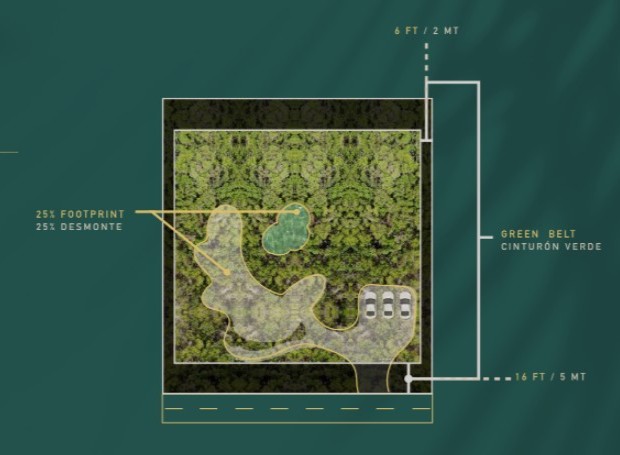
2,000 m² Homesite with 75% Native Jungle Preservation
Building with the land, not against it.
The community actively promotes
bioconstruction practices,
using materials such as Mexican-grown bamboo,
sustainably sourced timber, natural fibers,
and recycled materials.
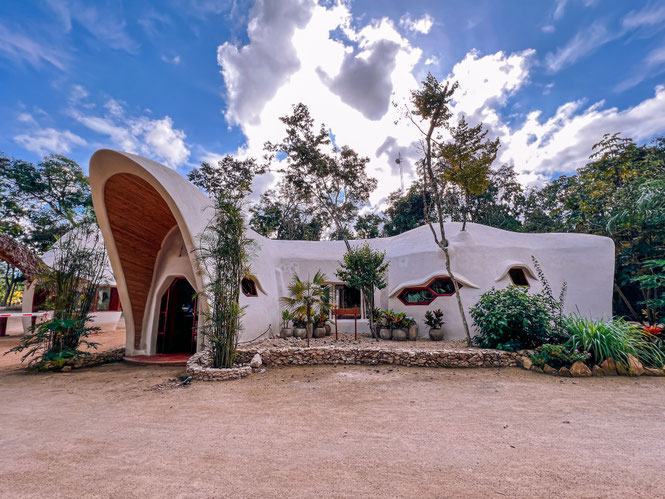
Multi-Purpose Community House
Constructed Using Bioconstruction Techniques
And there is something that very few people notice,
yet it changes everything:
• The natural topography of the land has been preserved.
In a region where the norm is to flatten and level the terrain,
the natural contours of the landscape have been preserved, allowing water to flow as it always has.
• Water is genuinely protected.
Each property incorporates
a three-stage wastewater treatment system
— aeration, digestion, and clarification —
ensuring that no water reaches the aquifer
without first being properly treated.
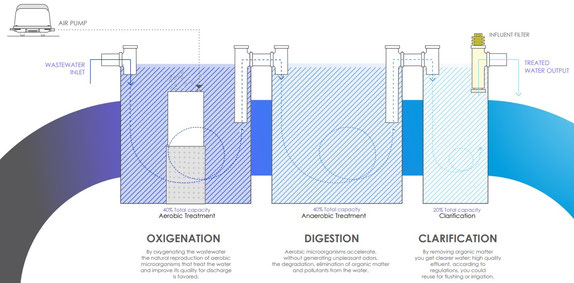
Wastewater Treatment System – Operational Diagram
- The community swimming pool operates
with an ecological water treatment system.
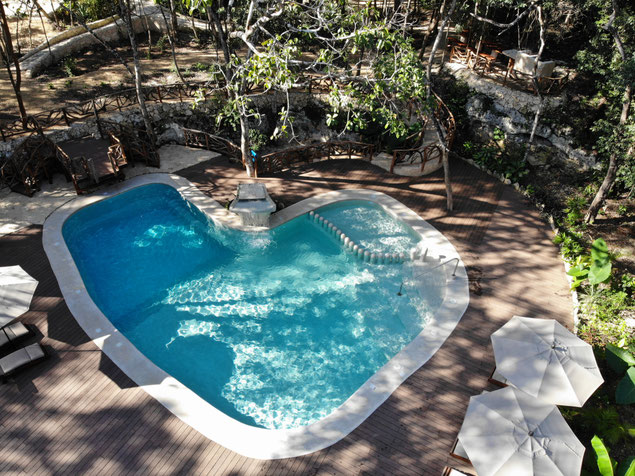
Bio-Pool in the Common Area
• The soil can breathe.
Instead of asphalt, the roads were built using sascab —
a natural limestone-based material
sourced directly from the land
during the construction process.
The very material that would typically
become construction waste elsewhere
is transformed here
into permeable pathways
that allow rainwater to infiltrate the ground naturally.
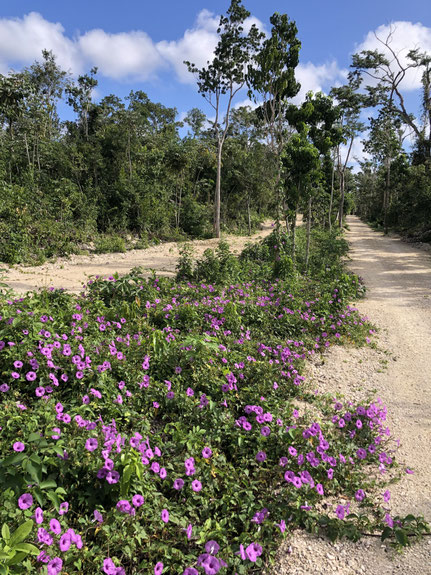
Internal Roads Built with Sascab, Reusing Natural Stone Materials Sourced from the Site
• The fences are alive.
Formed by living vegetation rather than walls,
they create natural boundaries
while preserving the free movement
of wildlife throughout the community.
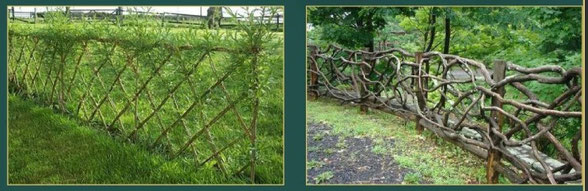
Examples of Living Fences
• The pathways are lined with fruit-bearing trees, creating edible landscapes that nourish both people and place.
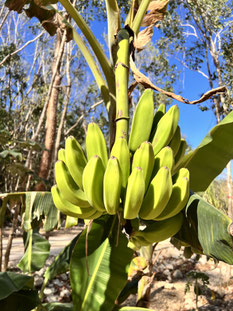
Edible Landscape Featuring Fruit Trees and Edible Plants
Along the Central Walkway
But perhaps the most powerful element
of this community is its intention to bring people together.
At its center stands a remarkable pavilion crafted
from bamboo and renewable natural materials,
designed to serve as the social heart of the community.

Community Pavilion Built from Bamboo and Recyclable Natural Fibers
Picnic areas, a natural-treatment swimming pool,
a cenote, a temazcal (planned) —
the traditional heat and steam structure
used by the Maya for purification and reconnection —
a children's playground, a calisthenics area,
and more than 2.5 kilometers of jungle trails
for walking and exploration.
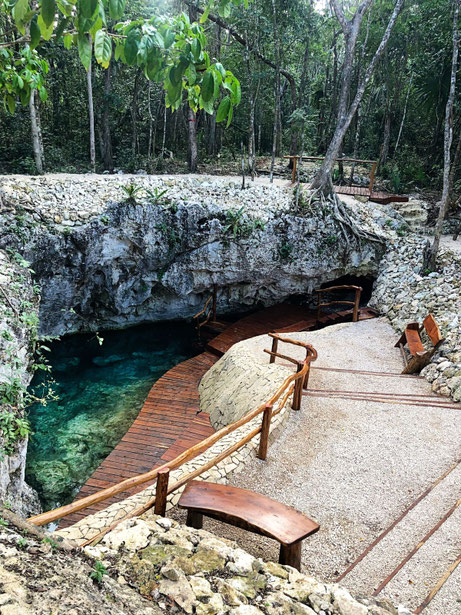
Natural Cenote
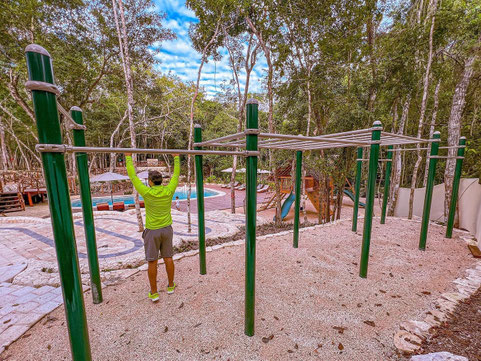
Outdoor Calisthenics Area
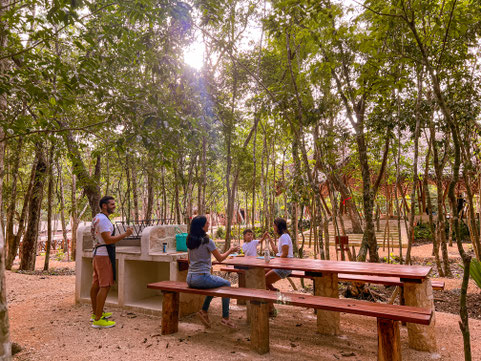
Picnic Area with BBQ Grills
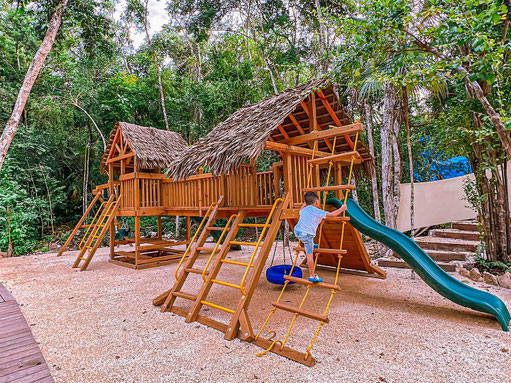
Children's Playground
All within a secure environment,
with controlled access and 24-hour security.
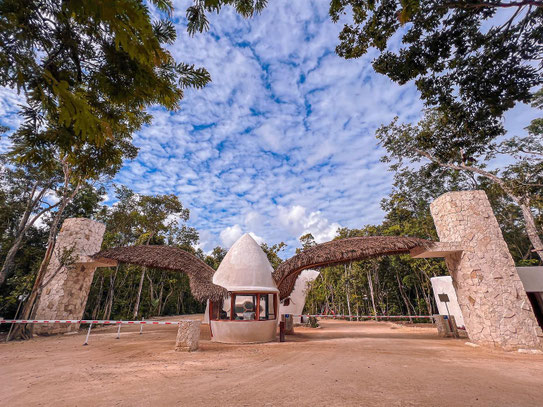
Access Gatehouse and Security Pavilion Built
Using Bioconstruction Techniques
In addition, each lot is connected
to the municipal water supply,
electrical grid, and high-speed fiber-optic internet.
Because living in harmony with nature
does not mean living without modern comforts —
it means not having to choose between the two.
Nature, community, and comfort.
Not as a promise. As a reality.
Your Roadmap to Becoming Part of This Community
If something you have read so far
resonated with you, here is what comes next.
There is no waiting list. No renderings.
The remaining lots are available today,
and the community can be visited as early as this week.
The path to becoming part of it is straightforward:
1. Take the first step —
complete the form using the link at the bottom of this article.
A conversation is all it takes to begin.
No commitments. No pressure.
Just clear and honest information
to help you determine whether this community
is the right fit for you.
2. Visit. Experience it.
No text, photo, or video can replace the experience
of being there. Walking the trails, listening to the jungle,
and feeling the scale of the project firsthand.
Schedule a visit and let the place speak for itself.
3. Move forward with confidence.
All legal documentation is in place.
Lots can be titled without delays or ambiguity.
In a market where legal uncertainty is often the norm,
certainty is part of what is being offered here.
4. Plan your project.
Once the closing process is complete,
the creative phase begins.
The community has established
a set of design and construction guidelines
that define the sustainability principles
and overall vision of the project —
a framework designed not to restrict,
but to inspire and guide each home
so that it contributes to the whole.
5. Build your sanctuary.
With intention. At your own pace.
Using the materials and architecture
that this environment deserves.
There is no rush.
You can begin when you are ready.
6. Become part of the community.
Because in the end, a community is not defined
by its buildings.
It is defined by the people who inhabit them,
the conversations shared in the pavilion,
the walks along the trails, and the neighbors who share a common vision of
how they want to live and what they want to preserve.
Thank you for being part of this community.
Until the next issue,
Luis Castillo Chollet (LuCas Chollet)
Write a comment